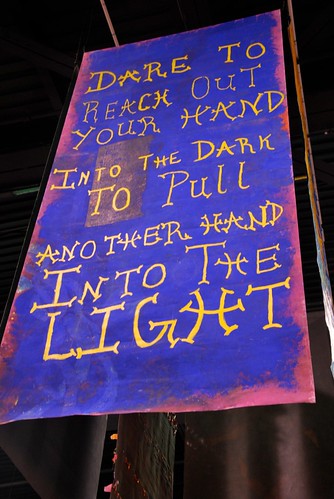
Thursday, May 22, 2008

"In Celebration of Ubuntu" -- by the Rev. Dahn Dean Gandell

I first heard the word “ubuntu” during the walkabouts prior to the election for Rochester’s 8th bishop. The Rev. Dr. Prince Singh spoke about ubuntu—the idea that “I am because You are”—the interconnectedness of us all. We elected Prince to be our bishop on the second ballot and he will be consecrated and installed in 12 days (Thanks be to God!)

When I opened the May, 2008 edition of Episcopal Life Monthly, I was thrilled to see that “Ubuntu” will be the theme for our General Convention in 2009. I am definitely sensing a movement of the Holy Spirit here. It seems to me that a commitment to the MDGs is a way of living into the spirit of ubuntu.

I don’t spend too much time on my computer. I always prefer talking to folks on the phone or seeing them in person. I had a friend introduce me to Yahoo Messenger and when I was signing up, I found that one of the options is to “appear invisible to everyone.” I was horrified. I know it’s just a way to manage availability, but the thought of appearing invisible to everyone made me really sad.

And then I got to thinking about the millions, perhaps billions of people on this planet who feel like they’re invisible to everyone every day, like no one really sees them or cares about them. The past two weeks have brought heart-breaking stories of cyclones, earthquakes, terrorist bombings, and wild-fires. My prayer is that we keep our eyes and hearts open and try to BE God’s hands at work in the world about us. We may not be able to travel to China or Myanmar or India to do relief work but we can pray for and financially support those who can. We can look for those folks who seem lonely or isolated in our own parishes or schools or offices or grocery stores and start a conversation. We can embody ubuntu.

p.s. Last month I wrote about introducing the MDG’s to some 8 o’clockers at a parish in our diocese. There were 7 people who attended that service and about 75 at the 10 a.m. service. After the 8 a.m. service, one of the women came up to me and pressed a twenty dollar bill in my hand and asked me to do something with it. I added $5 and funded a kiva loan to a 49 yr old woman with 6 children living in Cambodia.

The Rev. Dahn Dean Gandell is rector of St. John's Episcopal Church in Honeoye Falls, NY, and the MDG coordinator for the Diocese of Rochester.

Monday, May 19, 2008

"Us vs. Them" -- by Dr. Christiana Russ

I recently went to the presiding bishop’s summit on domestic poverty in Arizona. It was a wonderful think-tank comprised of people who do all varieties of work combating poverty in the United States. At the start of the meeting the point was made that while the Millennium Development Goals are important there is a need to focus on the poverty and deprivation that continues to persist within our own borders, despite our substantial GDP. This is absolutely true. It also made me sit back and think hard about our very human experience with limited resources and time, and thus our need to carve up how we spend those resources and time.

I am the chair of the executive council committee on HIV/AIDS and in our committee we have this conversation quite often. How much effort should we continue to put into pointing to the ever present but changing face of the AIDS pandemic in the United States? Does focusing on the international pandemic pull attention from the domestic problem and allow people to rest in false comfort of AIDS being ‘over there’? Or is there a way to see the commonality of the problems facing people both infected and affected by HIV in Africa, Asia, South America, our very own Province IX and in the borders of the United States?

In all of these places people face stigma, people face their fears of illness and dying, people struggle for access to healthcare, and family members care for orphaned children and ill loved ones. The magnitude of those particular problems might vary among individuals especially depending on their economic resources, but they are still very present and I believe the church is called to respond to every one of them.

We encounter a similar dilemma with poverty. I have heard people who work on domestic poverty dismiss international aid work as ‘sexy’ and lament the lack of people rolling up sleeves and going into their own backyards. Those comments fail to recognize that many of the problems of poverty are pretty similar in the U.S. and in Africa. I have met some of the loneliest and most deprived people imaginable while working with the homeless on the streets of Boston. And I have seen children alone and starving in Africa. Authentic relationship with each of those people forces us to face their needs which are enormous both materially and spiritually.

Good thing our God is so big and that His economics are all about abundance and love.

We also talked at the summit about having enough faith to dream big and step forward to do the work we are called to do… each according to his or her own gifts. The need of the world can be entirely overwhelming and yet at the root, many of the sorrows that people share across the world are the same. When we find those areas of similarity and focus on the synergy that can come from solving the same problem in different settings – amazing things can happen. When we trust in a God of abundance instead of viewing ourselves as competing for scarce resources or attention, again amazing things can happen. I pray that our church will have a big enough heart to care for people over there and over here.

Dr. Christiana Russ is a pediatrician doing her residency at Boston Children's Hospital, currently working at an Anglican mission hospital in Kenya through a joint arrangement with Children's and the Diocese of Massachusetts. She is also chair of the Executive Council Standing Commission on HIV/AIDS.

Sunday, May 18, 2008

"The prosperity Gospel and the MDGs" -- by Carl Hooker

I was not feeling all that chipper last Sunday and regretfully decided my physical presence in church would be a bad thing for my community given my level of cooties. I sat in my chair with my hot liquid and started to look for something on the TV that might return some religious feeling and perhaps take the place of being there. I came across one of those so-called mega-church preachers. Usually I would just pass Go and collect my $200, but for some reason I lingered and listened. I missed the first half and so was walking blind into whatever was left. I listened and was struck by the oddity of it all. It was pure and simple wealth religion. He never mentioned prayer, mentioned Jesus perhaps a handful of times but spoke often about God never intending 'you' to be poor or less than prosperous and I am pretty sure he meant money prosperous. The camera panned the large auditorium frequently with well-dressed folks holding Bibles and notepaper, all the while with a caption on the bottom of the screen advertising his new book ("available wherever fine books are sold").

How do you respond to that? What would happen if someone went into that congregation and spoke about the MDG's and global reconciliation? I do not know. I am NOT trying to pass judgment on them since it was a one time event and only for a portion of the total program, there is enough to be directed back to me and maybe that was the message; what was MY response to that excess, how should I react to hearing a gospel of prosperity of self and not community to say nothing of the world?

I am not sure what this means to me and the readers of this blog. I would like to sift through it though and for the next few months post my reflections here. If you have any thoughts or direction please reply to the post and let me know. Again, I assure you I am not looking to bash this sort of teaching, I am just trying to discern my response.

Carl Hooker is an economist employed in an academic healthcare system. He is an EGR diocese coordinator in the Diocese of Missouri, and currently studying in the diocesan school for ministry.

Friday, May 16, 2008

"Debt Relief -- 21st Century Jubilee" -- by the Micah Challenge

Today's post is from the Micah Challenge, a global Christian campaign to achieve the MDGs. Part of their mission is a weekly prayer emailing like the one you see below. You can receive it in your email box every week send a blank email to regine.nagel@micahchallenge.org with the words 'subscribe prayer' in the subject line.

In May 1998, 70,000 people from across BritainBirmingham and the world formed a human chain in to demand debt cancellation for the world’s poorest nations from the G8, the leaders of the world’s richest nations. This had an immediate and long-term impact on people living in poverty.

This day was a deeply spiritual experience for many, writes Stephen Rand, the co-chair of the Jubilee Debt Campaign in the UK. Why? Because people started to take the Bible and its call for justice seriously and acted in solidarity with the poor.

Please reflect on Leviticus 25 which outlines God’s principles for debt cancellation, freedom from the bondage of debt and ultimately a restored community.

Prayer

Let us pray:

  • Lord, we thank you for the impact that the campaigning on debt relief has had over the past 10 years. But looking at the statistic below, we realize that there is still so much more to achieve.

We pray for full cancellation of all unjust and unpayable debt that developing countries are currently burdened with. We pray for the IMF, the World Bank and other debt institutions to give future loans responsibly, on fair terms and in a transparent way.

  • Our prayer focus is for Micah Challenge Peru and their engagement in the Alternative People Summit in Lima this week.

Genaro Guerrero, the coordinator of MC Peru writes:

‘Please pray as we participate in the Alternative People Summit this week that is held parallel to the Fifth Summit of Heads of State and Government of Latin America/ Caribbean and the European Union in Lima.

Fifty-three leaders from Europe, Latin America and the Caribbean have confirmed their attendance at the May 16-17 summit where they are expected to discuss important issues as trade, climate change, poverty and the global food crisis. There is no doubt, that this meeting will be crucial for the future of our peoples.

Please pray that:

    • The Heads of States will consider poor people in their decisions!
    • The Alternative People Summit as we try to offer a critical analysis on discussions and agreements.’

Meditate on the Statistics

As you spend time in prayer and reflection, you may like to take a moment to silently understand with your heart the focus statistic we include each week (see below). Our hope is that you will find this series of statistics a useful resource in preparing presentations.

MDG 8: Develop a global partnership for development

Target 12: Develop further an open, rule-based, predictable, non-discriminatory trading and financial system.

‘The total external debt of the very poorest countries (the 'low income countries' which have an annual average income of less than $875 per person) was US $379 billion in 2005. During 2005, these countries paid nearly $43 billion to the rich world in debt service (payments of interest and principal) – that is $118 million a day.

These are the latest figures available - there has been some debt cancellation in 2006 and 2007, but there also have been new debts taken on. The overall figures are unlikely to have changed hugely.’

Source: Jubilee Debt Campaign UK http://www.jubileedebtcampaign.org.uk/?lid=98

This website also provides many facts and other information about the debt crisis.


Thursday, May 15, 2008

"How Much is Enough" -- by Meredith Bowen

This past weekend I hosted a fundraising event in my home town - in order to raise awareness and funds for the orphanange in Tanzania where I have volunteered. At the beginning of the evening a gentleman approached me and asked "How much?" "Excuse me?" I replied. He wanted to know how much was "enough" - he had a check in his pocket, he had come prepared to donate - I appreciated that. However, I was thrown. I had never been asked how much before. And I have been fundraising for years now. I didn't have an answer for him. I suggested that maybe he come back to me later in the evening, give me some time to think it over.

Why was this such a difficult question? More important, why did it upset me that this man had asked? As the evening began to come to a close - having been bothered by this encounter all night - it came to me.

There is no answer. At least not one that I will ever give. The answer is personal. If I give an amount I have basically let that person "off the hook" of having to decide themselves.

At the end of the evening I spoke briefly about my love for the orphans that I had been so fortunate to love over these last four years. I was frank with the crowd, encouraging them to write checks to support this endeavor. And I said, "If you are wondering how much is enough, "enough" would be the amount that you hope the person sitting next to you will make their check out for, especially if these children were your children. Because they are all of ours."

Meredith Bowen is at law school at Case Western Reserve University in Cleveland, spending the fall semester in Arusha, Tanzania doing an internship at the International Criminal Tribunal for Rwanda. Has volunteered in Tanzania with the Rift Valley Childrens Village (an orphanage) as well as with the Anglican Diocese of Mount Kilimanjaro and the Diocese of Tanga. Started the African Orphan Education Fund to award scholarships for secondary school and university.

Wednesday, May 14, 2008

"Love One Another: The Decade to Overcome Violence" -- by Jennifer Morazes


“Beloved, Let us love one another, because Love is from God. Whoever does not love does not know God, for God is love . . . God is love, and those who abide in love abide in God, and God abides in them . . . There is no fear in love, but perfect love casts out fear . . . The commandment we have from Him is this: Those who love God must love their brothers and sisters also.”

It sends chills down my spine to recite this particular passage. Isn’t it beautiful? For me, this passage is one of those which marks a cornerstone; one that, of the many messages of the gospels, points to at least one of their main themes.

Like the gospels themselves, it is difficult to pin down the “exact” message of the Decade to Overcome Violence. During my year in New York City working for the World Council of Churches, one of the main criticisms of the idea of this Decade was that it was too broad, not “exact” enough. “What kind of violence?” People would ask. The concept said everything and nothing at the same time, to some folks.

But to others’, including me, the Decade resonated deeply. Overcoming Violence spoke to me as a faith imperative, a faith imperative expressed in the above passage: Let Us Love One Another, because Love is from God. This is a perfect way to launch into what this Decade means for faith communities and for Americans. What I mean to convey to you today is not a formula or a program, but an introduction, a vision, and a spirit.

First, I have two stories for you, two stories which I would call Love Stories, but perhaps not in the tradition of George and Gracie, or even Brad and Angelina. These stories are about people I have cared about; and they are about people who, for me, were living examples of the impact of Love on our Lives, living proof that God is love, and those who abide in love abide in God, and God abides in them.

So, my first story is a local story, one that happened to me in my work in Boston last year, before working for the World Council. I went one night to a residential treatment program, as I was there to attend one of my client’s graduations. I worked as a reintegration specialist; this is a fancy way for saying I helped people in prison plan for their discharge, and followed up with them once they were out to assist them in carrying out their plans. So, I’ll call this client Jim in order to tell the story. Jim is a person I came to feel in awe of when I was in his presence, and I do not mean this in any idealistic, flimsy sense. Jim knew that he had made some bad choices, choices that affected both himself and others in his life. He had a criminal record about two inches thick, had spent maybe a third of his life in prison, and another third taking and dealing heroin. He had both scars in his arms and many nice cars to show for his efforts. In addition, Jim had AIDS, Hep C, and lived in daily physical pain. And, in the time that I had gotten to know Jim, he is very close to dying.

Yet, day in and day out, when he came into the program that I worked in, Jim did not complain. And so, as we would play Scrabble in the Drop In Center we would talk as I was getting creamed, and I would say, “Look, Jim, you have every right to be grieving, angry, upset. You don’t have to be so polite with me.” But Jim would not budge in his insistence that he was OK. Did he get angry? I’m sure. Did he cry, did part of him hate his situation? Yes. But one day he said to me “Look young lady, I’m not going to die in the street. I know people here care about me. I've got no reason to complain.” God, how brave he is, and what a spirit. He was a testament to John’s words: There is no fear is love; perfect love casts out fear.

Another story occurred half way around the world, in Southern Africa. Two years ago, I had the privilege of attending the Anglican Students’ Federation of Southern Africa’s yearly conference. I was inspired by the work of then student organizer Francisco Zandamela in his conviction that international ties must be formed around concerns such as viable economic solutions and HIV. The conference title was “Transforming Victims into Victors” and the point was that our call in our histories – personal, interpersonal, communal, even international – is not to be victimized by the past or what we may see as “failures." Instead, the process of identifying both the stones and seeds in our own hearts provides us with the potential for how we ALL can engage in the process of transforming our histories, through the promise of Christ, into victories.

Francisco almost single-handedly organized a conference for young adults on HIV, a very important conference for this very at risk population in Southern Africa. Through the conference, many young people were inspired to get tested and to change behaviors that may put them at risk. Another inspiring piece of the conference for me was seeing connections formed from people from very different parts of the world. For me, Francisco’s life, which ended tragically in a car crash six-months later, was a testament to John’s truth: Those who love God must love their brothers and sisters also.

So, one way to enter into the spirit of the Decade to Overcome Violence is by reflecting upon our own journeys of our selves in communities. Where have we beheld the transforming impact of love in overcoming violence? Our own histories can provide us with a lens through which to see others in our own and in different communities, appreciating both our similarities and differences and the power that lies in each. Here, from my own life, I describe two witnesses of love. There are many lessons to be gleaned about Love from these two stories, but the points I would emphasize as the take away message about love, is that 1) Love is Hard Work 2) We are the messengers, the bearers, the FRUITS of the Vine, of God’s love. And sometimes, recognizing that we are the FRUITS of God’s Love, is, in itself, the Hard work of Love. Within this lies a vision and a spirit of the Decade to Overcome Violence.

As you can tell, even though both of these stories are from my life, neither are about me directly, as a self-described “messenger of love.” In both cases, I was a little like Philip in the story of Philip and the Ethiopian Eunuch in Acts: God basically told me to get up and go. So, I got up and went. In both cases, I encountered someone: one person from a local community, another from a completely different country and context. In both cases, we had some similarities, but also some very significant differences, like the “Ethiopian” which Philip himself met. We sat side by side and shared, and we “baptized” each other from our exchanges.


Given our own stories, the example of Philip, the transforming impact of love and our place as “Fruits of the Vine”: Who are we being called to love, as members of a faith community, and as Americans with a place in today’s international scene? Where is our own hard work on Love’s behalf? How do we love people who are different, how do we form these connections, and how do we convince ourselves that we have the capacity to bring this love into reality?

So yes, here’s the hard part, why Love is such hard work: Even given Philip’s example today and the inspiring words of John and 1 John, to what extent do I, do we all believe the fact that we really are God’s fruits, to what extent do we believe, do we have faith in the fact that this love is in our hands? Thich Nat Hahn wrote in one of his books that as we move through life, we get “irritated hearts.” What an understatement! We’ve received messages from many places about how worthy or, perhaps even more memorable, how unworthy we are. We’ve received messages about what is “realistic,” or “possible.” What if Philip had considered his unworthiness or how “realistic” it was to joint the Ethiopian and never gotten into the chariot? A connection between two people, two very different people, would have been missed. And so would the opportunity for sacrament, for baptism.

The quote I think that best illustrates this process is one made by one of my spiritual mentors, Archbishop Desmond Tutu. He wrote and has preached that the most evil thing about apartheid is that it convinced God’s children that they were not God’s children. Working analogously and in synchronicity are the myriad ways in which we have encountered violence ourselves, the ways in which we have been told, even by those we care about and who care about us, that we are not the FRUITS that we are. In our minds, in our hearts, and even our physical bodies, we are not unlike Moses, who, as God has called us to Overcome Violence, we say “Oh God. But I have never been good with words. I don’t want to be responsible. Please ask someone else.”

In our imperfectness, our woundedness, we continue this cycle of hurt, we inflict it upon others and upon ourselves, internalizing the pain and even recreating the pain in our own lives. How many times in these cycles of violence do we either inflict our hurt upon another or internalize the hatred onto ourselves? And these realities, these conditions that run antithetical to love -- addiction, and trauma and oppression -- all make our hearts more than “irritated”, but downright festering wounds!

But, as Philip shows us, we can all get into the chariot. We can. Both Jim and Francisco, in different ways, exemplified love for me, and I had the gift of knowing them by climbing into the chariot, by taking that chance and trusting love. This is way we break the “cycle of violence” and Overcoming Violence, by being open to the possibilities and believing that we are worthy to receive them.

In this season of Easter, of rebirth and renewal, let us remember that love is a process, a verb, a condition, a way of being in the world with ourselves and others. Love exists in being, in being who we were created to be, in confronting the challenges of faith that have been set before us in our individual paths and I’ve climbing into the chariot next the “the Ethiopian,” as challenging as that be. We all have been given true examples of this process of love, in our lives and in the lives of our spiritual leaders, like Philip. Through Jesus’ being born against all odds in a manger and his acceptance of his call, love became. Through Mohammed answering God’s call and bringing his ministry into the world, love became. Through Hagar, Mohammed’s very great grandmother, through her cries in the wilderness and her calling upon God’s name (the first person in the Bible who did theology) the possibility of love was born. Love exists in the be-ing, this becoming, in the transformation of our grief and fears by making the choice to love and create the reality of unshakeable hope. Let us see ourselves as God’s branches, and reach, and bloom. Amen.

For the full text of this sermon, click here.

Jenn Morazes is a graduate of Episcopal Divinity School in the area of Theology and Contemporary Society. Currently studying in the School of Social Welfare in the MSW/PhD program at the University of California, Berkeley. Jenn has studied and performed community work in both Mexico and Southern Africa and also participated in the Young Adult Stewards Programme with the World Council of Churches in Geneva, Switzerland. She has also served as an anti-racism trainer for the national Episcopal Church. Her current clinical work and research focuses on the impact of trauma on particular communities locally and internationally, as well as homelessness,wealth distribution and the role of faith communities in social development.

Monday, May 12, 2008

"Germany, Congo, Darfur, Rwanda" -- by Dr. Josh Ruxin

April 7, 2008, was the 14th anniversary of the commencement of Rwanda’s genocide. With periodic massacres that date back to 1959, Rwanda’s genocide did not happen overnight. Its climax, however, began April 7, 1994. It was a few days later that 36-year-old Epafrodite Rugengamanzi was murdered. From what his sister, Josepha, has gathered, he was chased into the yard of the house where we now live, brutally killed, and buried. Her brother’s killer confessed to the murder during gacaca — the traditional court process for genocide suspects — and brought her to his burial spot.

The disinterment of Epafrodite RugengamanziThe disinterment of Epafrodite Rugengamanzi

Josepha came to our house Wednesday with other family members and dug up her brother’s skeleton. The orchestrated process took several hours. Once they were sure that all of his bones had been collected, they carefully cleaned them. Josepha then asked me and my family to come over and listen to their testimony (and asked us to share it with others). Josepha was smiling and told us how lucky she felt to have found her brother’s bones and to be able to re-bury them shortly at Gisozi, the national genocide museum and burial ground.

Epafrodite RugengamanziEpafrodite Rugengamanzi
Josh Ruxin with JosephaJosh Ruxin with Josepha

Epafrodite’s murder was avoidable, since the UN had the power to prevent it. Ultimately it was not an international team of peacekeepers who brought Rwanda’s genocide to a close, but rather, the Rwanda Patriotic Army, a disciplined military force drawn from Rwanda’s diaspora. After years of fighting, the Rwanda Patriotic Army on July 4, 1994, brought stability to the country. Human Rights Watch, a French judge, and a Spanish judge allege, however, that the Rwanda Patriotic Army carried out thousands of reprisal killings and crimes against humanity during and after the genocide. President Kagame publicly bristled this past week over the recent Spanish indictment.

A close look at the complexities of Rwanda’s genocide would remind China’s leader Hu Jintao, President Bush and others of the path history can take, yet does not have to. Darfur is at least beginning to take on some of the dimensions of Rwanda: a gradual genocide in a region still lacking an adequate peacekeeping force and the political commitment to bring it to an end. The carnage there continues and now a new genocide threatens in Southern Sudan. While hope has so far proven elusive for Sudan, it is even harder to imagine that its people will get themselves on Rwanda’s track to peace and prosperity anytime in the next few decades. Rwanda’s resilience and approach are exceptional.

My friend and head of Orphans of Rwanda, Jean Baptiste Ntakirutimana, wrote me the other day about his meeting last week with his mother’s killer: “I inquired first about his life in prison, his family and his state of mind. He said he was expecting that I could kill him, which he thinks was the way of doing justice for having killed my mum. He added that no one dared killing my mum; that she was brought by two militia to her home village and called for people to come and kill her. No one did so besides him who felt he had to kill her. In fact he told us that they were told that no one was allowed to loot from Tutsis before killing all their family members. Since they thought I was already killed from Kigali, where I was residing, the only hindrance to take all the family property was my mum. So she had to be killed. By the time he started explaining how he killed her I partly lost consciousness. I prayed to God to give me His spirit to revive me and give me more strength to continue, as I felt it was His mission I was on. Miraculously I felt warmth from my head to my feet, I felt like a big rock melting from my chest and my head. I felt very refreshed, cleaned up my tears and carried on the conversation tremendously relieved from my whole being. I then told him that I have personally been forgiven all my wrong from God and that it is in the same spirit that I was coming to him offering him pardon myself. Then it was like a huge veil off his face he started smiling with a lot of words of gratitude. He started holding my hands and telling me many other things I couldn’t expect about himself and the reality around the genocide. He agreed to go and see other people for whose family members he killed.”

Fourteen years later, Rwandans are still struggling to reconcile the past. The struggle, however, is proving easier against a backdrop of national stability, economic growth, and a rising national profile. Foreign investment is at a high, there are swank hotels, and tourists are coming by the thousands.

Post-genocide history is mired in enduring civil conflict and instability. Rwandans know firsthand that exports such as peace and stability are far superior to tales of disaster, massacres, and corruption. Rather than provide the object lesson of what can go wrong, Rwanda now embodies quite a different ideal. The nation was one of the first to send peacekeepers to Darfur and today has one of the largest contingents on the ground. Nothing points more clearly to Rwanda’s recovery and resolve.

Josh Ruxin is a Columbia University expert on public health who has spent the last couple of years living in Rwanda, where he administers the Millennium Villages Project in Mayange. He’s an unusual mix of academic expert and mud-between-the-toes aid worker. His regular posts (including this one) can be found on the blogroll of Nick Kristof of the New York Times, and he has given his permission to be cross-posted here. Josh and EGR executive director Mike Kinman team-teach a global poverty module for Trinity, Wall Street's Clergy Leadership Project.